Yeah. I would have guessed the same. I would have expected this piece to begin with “Welcome to Stratton Oakmont, my name is Jordan Belfort.” However, it did not. All I can tell you is that a $1,000 investment in TSLA stock ten years ago would be worth $153,857 now.
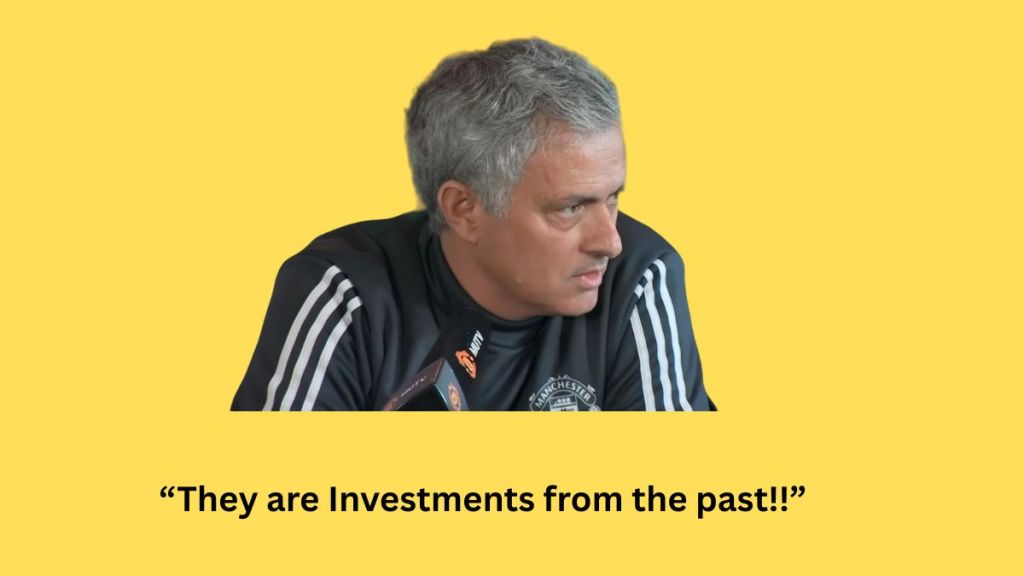
I might have used this title to emphasize the value of investments, but Jose Mourinho’s words inspired me to do so. We could say Jose has a knack for titles, eh? In an interview following the turmoil of his former team, Manchester United, he underlined the significance of keeping to a core and drew contrasts with their noisy neighbors, Manchester City, to highlight the enormous gap between them.
Little did he know that his words would inspire an article. Before we dive in, I guess it’s time to give him the respect he deserves. The honors Jose achieved over the years will undoubtedly live on in perpetuity, but it is time to recognize what he did in places where he got shunned. He was indeed a visionary.
In that specific interview, Mourinho chose not to hold back and presented an intriguing point regarding his team’s prior success and contrasted it with Manchester City’s. Mou cited a few players in whom City had previously invested and coined the phrase “investments from the past.” People were never really keen on listening to those, and he was fired months later after yet another abysmal performance against old rivals Liverpool.
What Are Investments?
No, not the sponsors on the jerseys. The term may sound familiar to anyone interested in stocks or trading. Investments are assets or items purchased to generate income or gain over time. When you buy a share, you are purchasing a piece of the company, and you are entitled to a cut if the company makes a profit. Mou referred to an investment that does not occur during an initial public offering (IPO).
He meant investing in players and establishing a core around which a team can be built, and managing transfers accordingly. A team hires a manager based on his personal ideologies with a common goal. The team plays the way the manager wants them to, and he wants players who can aid his system. These are the fundamentals of core-building and success. There is no blueprint for success for teams.
Spurs would have won some if there had been one. As our predecessors have already stated, there are no shortcuts to success, but there are means. Over the year, this has proven to be worthwhile. We’d use instances from three different sports to assert my argument.
The Chicago Bulls in the ’90s.
Don’t you think TV hosts enjoy playing games? If you’ve ever seen the games they play while interviewing someone, it’s the one where they utter a word, and the guest has to say the first thing that comes to mind. If we played that game and I mentioned basketball, three of my four readers would immediately think of Michael Jordan.
Jordan has a larger-than-life reputation thanks to his on-court theatrics and his tendency to take things personally off the field. He won SIX rings with the Chicago Bulls. Jordan may be the greatest of all time, but he didn’t win his six championship rings by playing 1v5. In 1984, he joined the Bulls. He was the initial member of the band, which later included Bill Cartwright, Scottie Pippen, Horace Grant, B.J. Armstrong, and others.
These guys arrived years before Chicago won its first championship in 1990-91.
Jordan retired, returned, and won the three-peat. Scottie Pippen was balling out, and Phil Jackson was still coaching. A new-look core with stars like Rodman helped them win the three-peat. Jordan won his first title six years after joining the Bulls in 1984. They won with a core they devised years before the tournament.
The Giants of the Indian Premier League (IPL)
The pivotal players in Mumbai and Chennai were responsible for their success. MSD reached the finals and semi-finals before winning it on his third attempt, but he kept his core and won it in 2010 and 2011. After a two-year ban, the Super Kings managed to keep their core players they had before the auction and won two trophies in the four years that followed.
MI recognized the strategy and let go of some deadwood while keeping players from the 2010 finals. Pollard, Harbhajan, Malinga, and Rayudu are among the players. They needed a leader and got one in Rohit Sharma, a homegrown talent. After identifying a new-faced core in the Pandya brothers, Rohit, Pollard, and Bumrah, they invested in several young players during the major auction in 2018. This led them to win the double in 2019 and 2020.
The two most successful IPL franchisees are the only two teams that don’t mess around with their starting XI and stick to specific players while still developing the youth. Imagine my shock.
Consistent Performers
Teams that consistently play in the Champions League have either won the league or placed in the top four to clinch a place in Europe. Teams like Bayern Munich, Juventus, Real Madrid, and Barcelona are usually the ones vying for the title. Real Madrid, the reigning Champions League champions, have used the same midfield since the British invaded India. Fans chastised the board for selling their legendary goalie Navas and replacing him with Courtois. They had no idea he’d end up being the match-winner in the Champions League finals years later.
Barcelona, Madrid’s adversary, was dominating the world under Pep with players who had been playing prior to his arrival. Their academy produced Xavi, Iniesta, Piqué, and Messi. La Masia was the first to identify them. These are the teams that stick to certain principles and non-negotiables.
In addition, they are one of the most inactive teams in the transfer market. It’s not that they’re impoverished; it’s just that they don’t see the need to replenish the roster with new players every season. “Their investments from the past,” I say again in that sultry tone.
Manchester City frequently gets chastised for spending millions, but they are the first to have dominated the Premier League with a well-planned system and ever-present players. As I previously stated, there is no success manual, but I do feel that there are methods that have proven to be effective. Those are the fundamentals. You may spend millions and end up looking like Nottinghamshire forest.
The quality gap between them and other teams is enormous, but if they enforce what they did this summer routinely, they have the potential to become a formidable force. Success cannot be bought, but it can be built. Cheers, all good.


 CRINNIT
Leave a comment